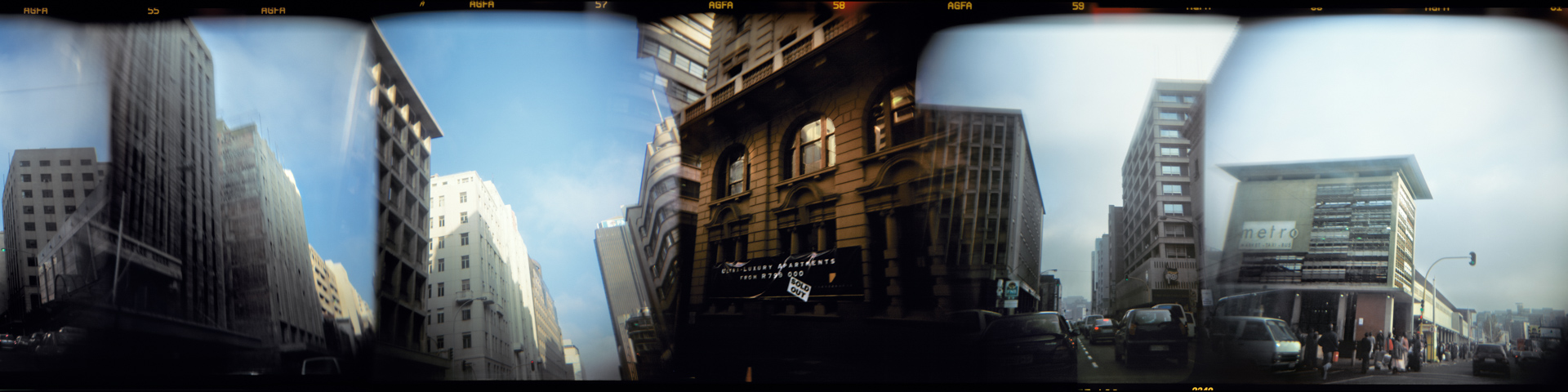
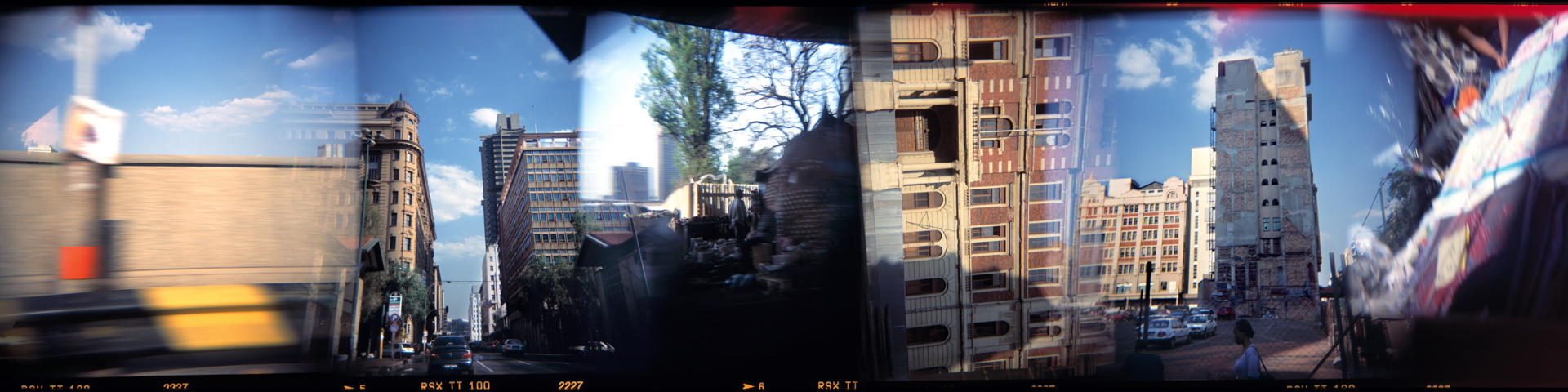
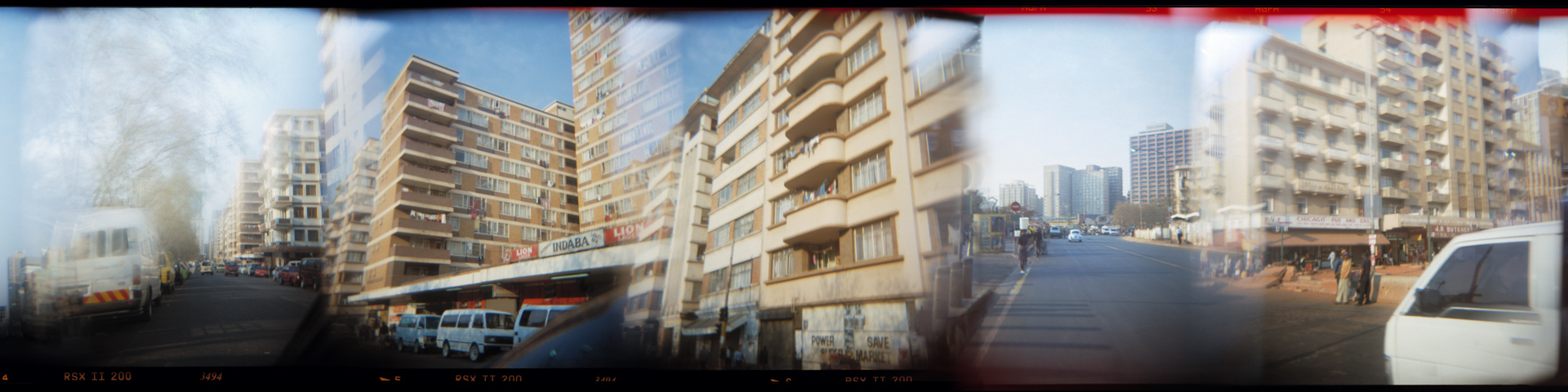
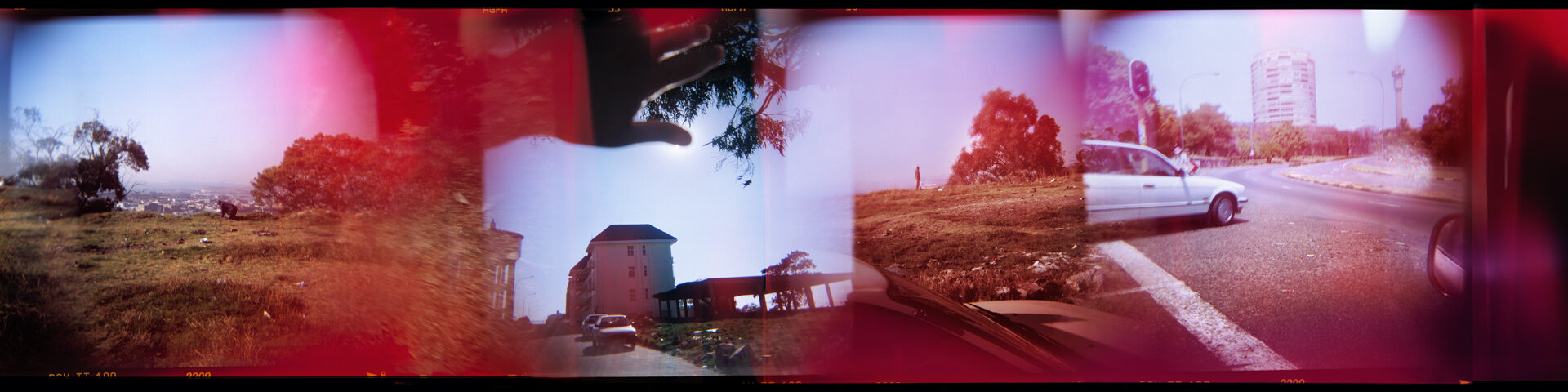

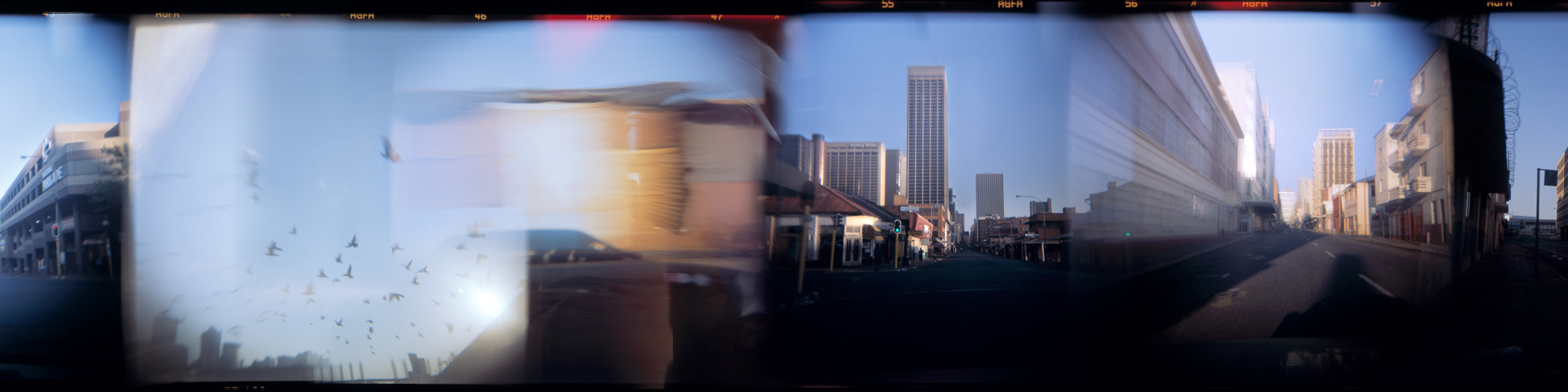
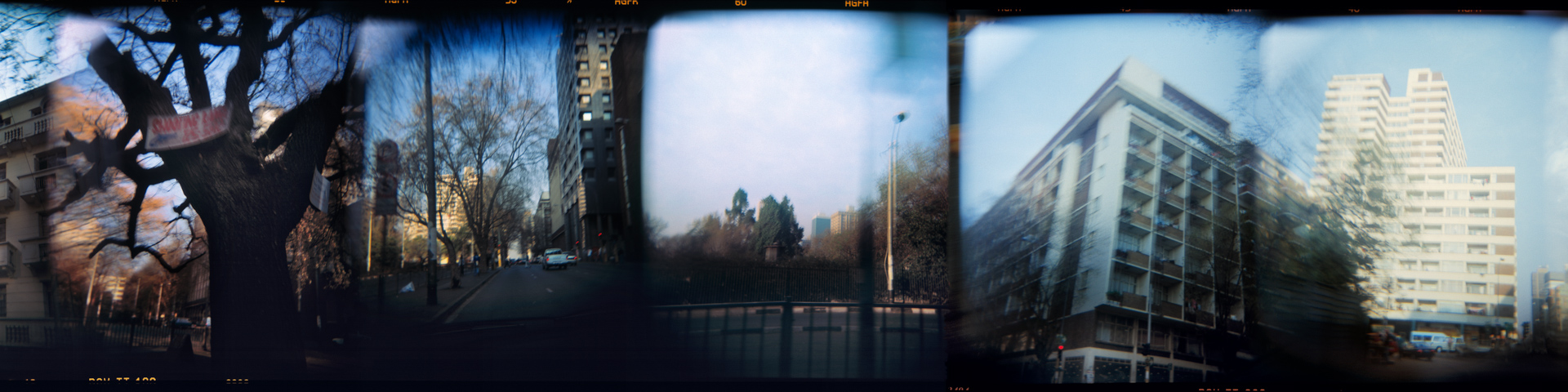
Johannesburg inner city works 2000 – 2004
Holga is the brand name of a plastic camera. It holds medium format film, has a fixed focus, plastic lens and no exposure controls. I found that the plastic framing device of the Holga could be removed, which took away the clear separation between frames and allowed the edges of each to spill over into the next. As such, I could shoot an entire roll of film in one uninterrupted sequence. And depending on how I framed things – juxtaposed one image to the next and shifted my point of view – I could narrate space in various ways – and ‘in camera’, rather than manipulating the image on a computer.
Photographing Johannesburg, I wanted to find a way of seeing that approximated my experience of the city. The Holga felt like the perfect tool, facilitating a kind of coming to ‘see’ by feeling, as opposed to a detailed scrutiny, emptying out the centre of vision while paying attention to the peripheral. This expressed Joburg, this city of slippages, this place you cannot apprehend in any fixed way. Joburg reveals itself in a continually shifting phenomenon; its buildings, its people and its streets catch you unawares and hover, half-blurred on the edges of your vision when you’re on your way to something else. A city that constantly shifts your knowledge and experience of it each time you think you might have found what you are looking for.
June 2026
Jo Ractliffe ((b. 1961 Cape Town) studied in Cape Town at the Ruth Prowse School of Art and the Michaelis School of Fine Art.
Her photographs reflect her ongoing preoccupation with the South African landscape and the ways it figures in the country’s imaginary – particularly the violent legacies of apartheid. In a country with a powerful tradition of social documentary,
Ractliffe is known for her distinctive approach in portraying the ‘after-event’; spaces haunted by the lingering presence of a violent past. Her images draw our attention to the absent and unseen, traces of meaning beyond the evidentiary. Describing her as ‘one of the most accomplished and under-rated photographers of her generation’, the late curator Okwui Enwezor referred to her work as ‘a photographic antidote to documentary literalism’.